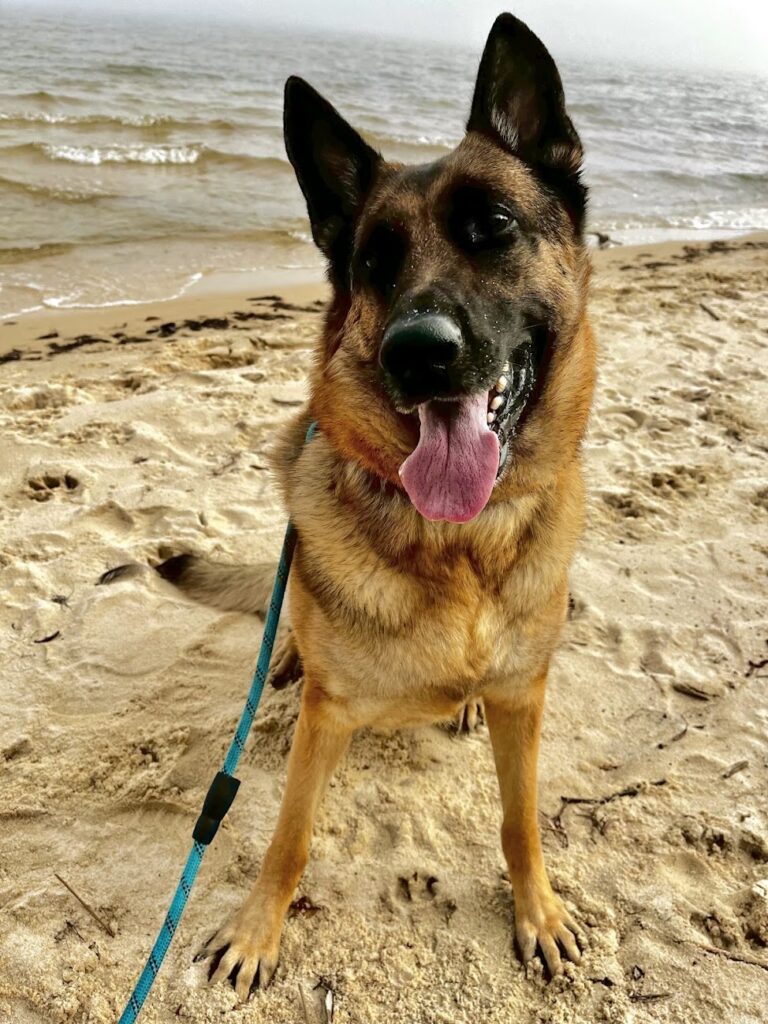
I’ve had dogs my whole life—basically grew up in a house where shedding was a personality trait. And now I’ve got this absolute unit of a German Shepherd named Demi. She’s so smart it’s honestly starting to get annoying. Like, I’m pretty sure she understands taxes at this point.
Since childhood, I’ve had many dogs, and my current companion is a German Shepherd named Demi.
Demi’s first time at the beach.
Training a dog takes patience, consistency, and a whole lot of positive energy. Seriously, you can’t just yell “Sit!” like you’re calling bingo numbers and expect magic. You gotta be calm, you gotta be steady, and you gotta cheer them on like they just won a gold medal for not eating your shoes.
So here are some steps to help you train your dog the right way—Structured, drama‑free, and guaranteed to make you both look good.
Start with Basic Commands
Training a dog starts with the basics—patience, consistency, and a whole lot of “Good boy! Good girl! Please don’t embarrass me in public.” Teaching basic commands is like Dog Parenting 101. It’s not just responsible… it keeps you from looking like that person at the park whose dog is doing parkour off strangers.
Start simple: “sit,” “stay,” “come.” These are the foundation. The ABCs. The tortilla before the taco.
When I first got Demi—my awesome dog who thinks she’s the CEO of the house—I started with these exact commands. And trust me, she picked them up fast. I’m over here trying to teach “sit,” and she’s looking at me like, “Bro… I’ve been sitting…”
But here’s the thing: these basics are merely the foundation. Like when you’re teaching fetch. You throw the ball, and you want your dog to bring it back—not sprint off like they’re starting a new life in another state. That’s where “come” saves the day. If they don’t know “come,” you’re not playing fetch… you’re doing cardio.
So start with the simple stuff. It’ll make everything else way easier, and you’ll look like you actually know what you’re doing.
Be Consistent
Look, if you’re gonna train a dog, you gotta be consistent. You can’t be out here saying “sit” one day and “park it” the next like your dog’s supposed to speak five languages. And don’t even get me started on the rest of the household. If everyone’s doing their own thing, your dog’s gonna be standing there like, “Which one of you clowns am I supposed to listen to?”
Use the same commands, the same rewards, every time. Make it simple. Make it predictable. Because if you confuse your dog, that’s on you—not them. They’re just trying to figure out why one person says “stay,” another says “hold up,” and someone else is offering treats for absolutely nothing.
Get everyone on the same page, or your dog’s gonna start running the house out of sheer frustration.
Use Positive Reinforcement
Alright, here we go—positive reinforcement. Yeah, apparently this is the big secret to training your dog. You can’t just yell “HEY!” like some lunatic and expect them to magically understand what you want. No, no, no—you gotta reward them. Treats, praise, playtime… basically you turn into a cheerleader every time they don’t act like a complete maniac.
Your dog sits? Boom—treat. They stay? Boom—praise. They don’t knock over your coffee for once? Give ’em a parade. And the crazy part? It actually works. They start thinking, “Oh, when I don’t behave like a wild animal, good things happen. Interesting.”
But timing is everything. You can’t give them a treat five minutes later when they’re already sniffing the neighbor’s yard like they’re solving a crime. You gotta reward them right away so they connect the dots. Otherwise they’re like, “Wait… was that treat for sitting or for eating the sock?”
Stick with this positive reinforcement stuff and you’ll end up with a dog who’s well‑behaved, confident, and actually happy to listen to you. And honestly, that’s a miracle—because half the time it feels like they’re just tolerating us.
Keep Training Sessions Short
Dogs have tiny attention spans, man. I’m talking tiny. You start training and five minutes later they’re like, “Ooooh look… a leaf!” So keep your sessions short—5 to 10 minutes. That’s it. Anything longer and your dog’s mentally checked out, thinking about snacks, squirrels, or whatever secret mission they think they’re on.
Make it quick, make it fun. Do a little “sit,” a little “stay,” a little “who’s a good boyyyy,” and boom—training session over. Your dog’s happy, you’re happy, nobody’s stressed, nobody’s confused, and nobody’s running in circles… except maybe the dog, but that’s normal.
Do a few of these mini‑sessions throughout the day. Your dog will be like, “Ohhh we’re doing the thing again! I love the thing!” And suddenly training becomes this fun little routine instead of a full‑blown lecture.
Socialize Your Dog
Socializing your dog is super important, man. This is like taking your dog out into the world and saying, “Alright buddy, these are people… these are other dogs… and that thing over there? That’s a vacuum. Don’t freak out.”
When you socialize your dog, you’re basically helping them become cool, confident, well‑rounded little fur‑citizens. You want them to meet all kinds of people—big people, small people, loud people, the guy who smells like barbecue—everybody. And other dogs too! Big fluffy ones, tiny chihuahuas with that “I run this place” attitude… all of them.
Because if you don’t socialize them, that’s when you get the problems. Fear, anxiety, barking at shadows, acting like the mailman is a supervillain. But when you do socialize them, suddenly your dog’s like, “Ohhh okay, the world isn’t scary. I got this.”
A well‑socialized dog is easier to train, happier, and way more relaxed. They walk into new places like, “Hello everyone, yes, I am adorable, thank you for noticing.” And honestly, it makes your life easier too. No drama, no chaos—just a confident, friendly dog who makes your home and your neighborhood a better place.
Be Patient
You gotta be patient when you’re training a dog. I know, I know—nobody wants to hear that. You want your dog to get it right now, like you’re teaching a genius prodigy. But no, your dog’s over there sniffing the floor, thinking about snacks, completely ignoring the fact that you’ve said “sit” twelve times. And you can’t lose your mind about it.
Every dog learns at their own pace. Some pick things up fast, others look at you like you’re speaking ancient Greek. And that’s fine. You can’t get frustrated and start ranting—well, you can, but it’s not gonna help.
Just stick with it. Keep showing them what you want, keep rewarding the good stuff, and over time they’ll get better. Slowly. Like watching paint dry, but cuter.
Eventually, they improve. They really do. And one day you’ll look at your dog doing exactly what you taught them and think, “Wow… it actually worked. I’m a freakin’ miracle worker.”
Seek Professional Help if Needed
Sometimes training your dog is easy… and sometimes you’re standing in your living room like, “Why are you looking at me like I’m the one who doesn’t get it?” And that’s when you know—yeah, it might be time to call in the pros.
There’s no shame in it, man. None. I’d be the first one to say, “Look, if my dog started ignoring me like a teenager with headphones on, I’m getting help immediately.” Trainers exist for a reason—they’ve seen every kind of dog, every kind of attitude, every “I don’t feel like listening today” moment.
You can sign up for a class, get a professional trainer, whatever works. These people show up like, “Hi, I speak fluent dog,” and suddenly your pup is sitting, staying, and acting like they’ve been training for the Westminster Dog Show.
And the best part? It makes your life easier. Less stress, less confusion, more “Ohhh look at my good boy!” moments. Sometimes all you need is a little expert help to get things back on track.